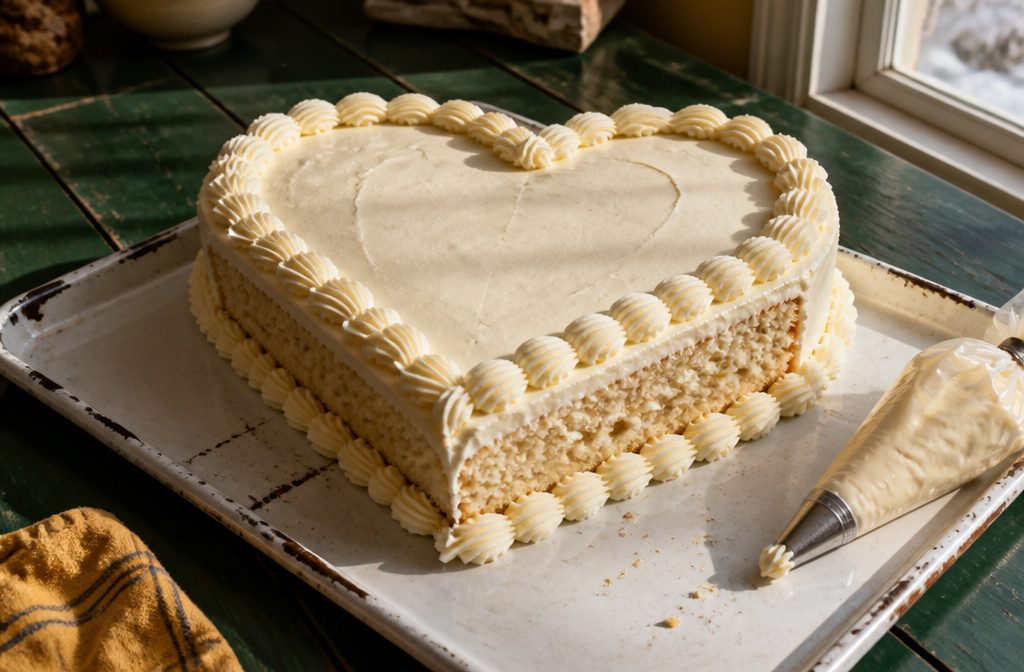
A boxed mix baked in one 8-inch square pan and one 8-inch round pan (30–35 minutes) becomes a heart once you halve the round and press the halves against the square’s upper sides.
The platter must be at least 14 inches square, and vintage shell borders piped with Wilton 4B finish it.
Heart Cake Ingredients
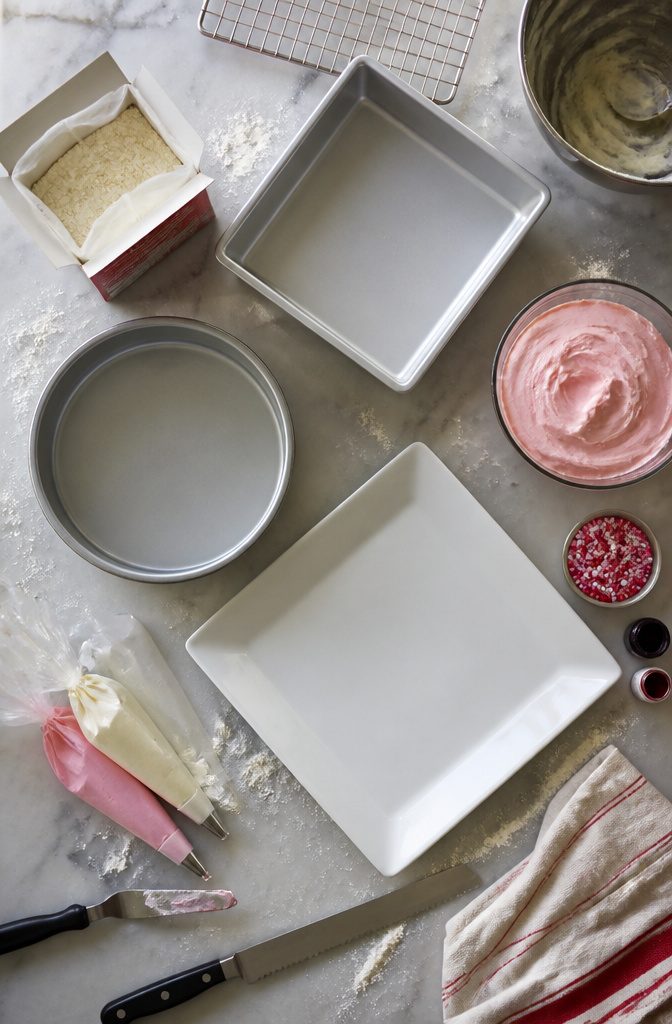
You need one box of cake mix in any flavor (or a homemade cake recipe) baked in one 8-inch square pan and one 8-inch round pan.
Coat the pans with baking spray or butter, then dust with 1 tablespoon flour to prevent sticking.
For frosting and decorating, you’ll need:
- 3 cups buttercream, cream cheese frosting, or one tube of ready-made frosting
- Sprinkles or other decorations of your choice
- Gel food coloring if you want to tint white frosting
The equipment is probably already in your kitchen:
- A platter at least 14 inches square to hold the assembled heart
- A serrated knife for cutting and trimming
- An angled spatula for frosting
- A few piping bags if you plan to add borders or vintage details
You can use 9-inch pans instead of 8-inch, but the cake will bake thinner and finish faster.
How to Make a Heart Cake
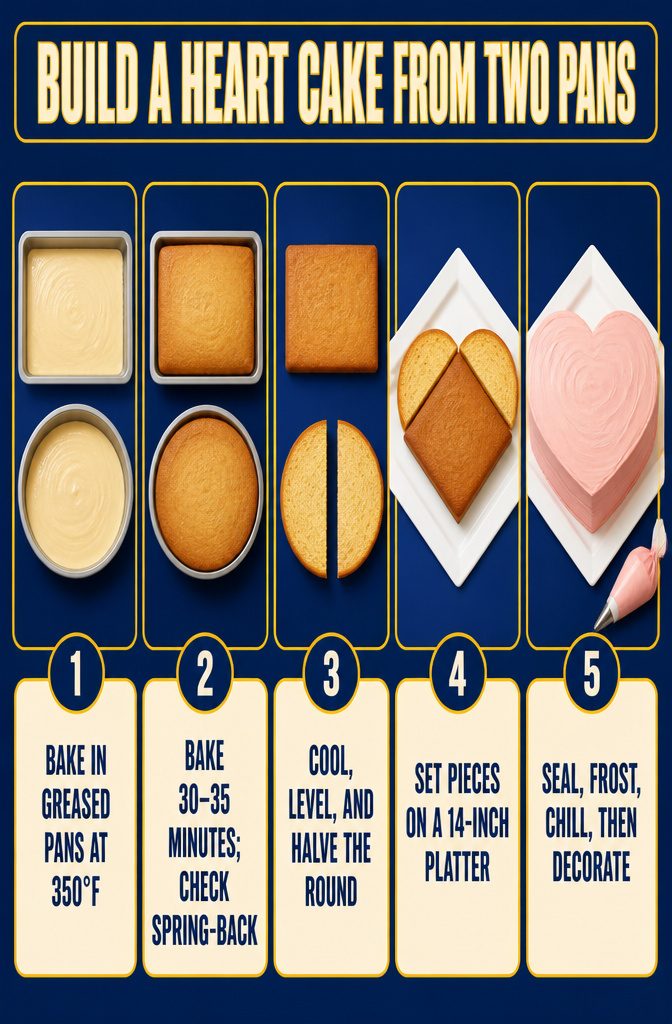
- Heat the oven to 350°F. Coat an 8-inch square pan and an 8-inch round pan with baking spray or butter, then divide the batter evenly between them.
- Bake 30–35 minutes, until the tops spring back lightly when touched.
- Cool 10 minutes in the pans, turn out, and cool about 30 minutes more. An optional 30-minute freeze makes the crumb less fragile. Level any domes.
- Cut the round in half with a large serrated knife.
- Set the square on the diagonal on a platter at least 14 inches square. Press the halves against its two upper sides.
- Fill and seal the seams with frosting.
- Crumb coat the whole cake, then chill until firm.
- Frost the top, then the sides, smoothing as you go. Chill at least 20 minutes.
- Decorate, then pipe a message if you want one.
Heart Shapes Without a Heart Pan
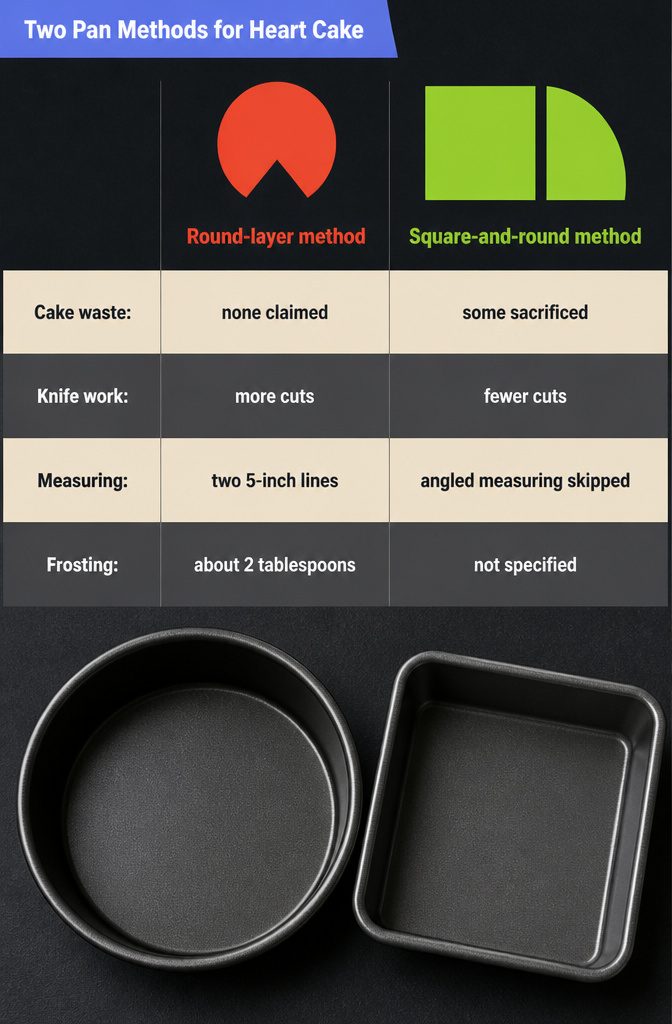
Two ordinary pans form a heart in two different ways. Cut and reposition round cake layers or pair a square with a halved round.
The recipe above uses the round-layer method because it avoids wasted cake, marking two five-inch lines at a right angle to form the point and attaching the cut-offs with about two tablespoons of frosting.
The square-and-round approach fits the pans you already have if you keep one of each size, and it skips the angled measuring, but you sacrifice some cake in the process.
The round-layer method wins if you hate throwing out good cake and don’t mind a bit more knife work.
Place the first layer on a cutting board, mark your cuts, and repeat with the second using the first as a template.
The pieces you remove become the rounded top curves. One source notes no wasted cake with this method, though no head-to-head test backs the claim.
Larger and Layered Versions
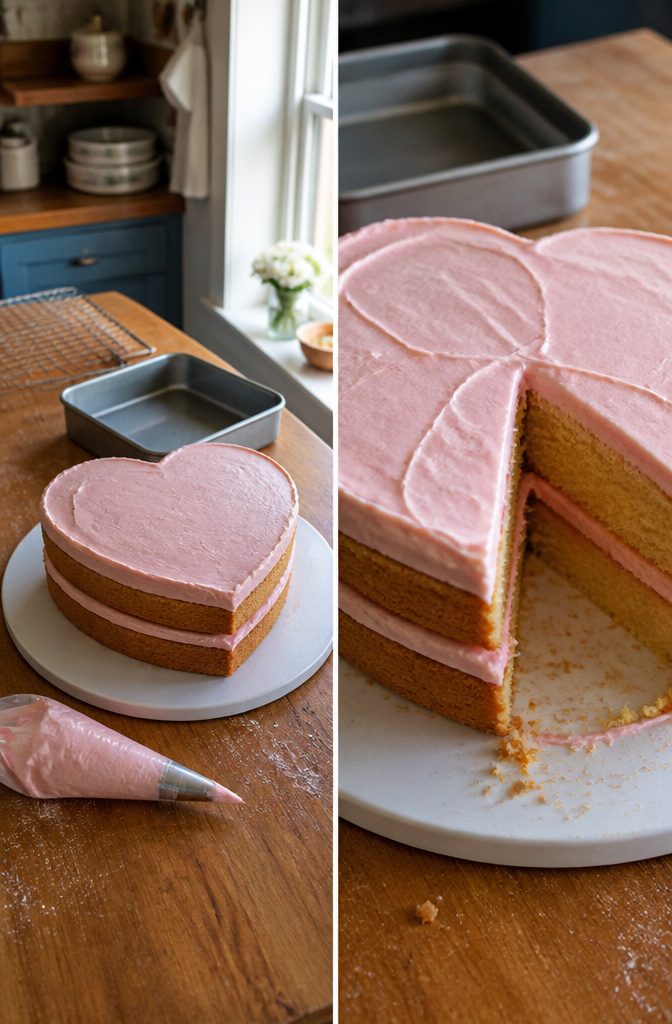
For a bigger heart, use a 9-inch square and a 9-inch round pan, or go up to 10-inch pans.
Double the batter, or the layers bake up thin. The finished heart will also outgrow your usual serving plate, so choose a larger platter before you start cutting.
The 9-inch pans bake a wider, thinner cake in less time than 8-inch ones, so start checking for doneness early.
For a layered heart, double the recipe and bake 2 round and 2 square cakes in 8-inch pans.
Assemble one heart, fill or frost it (a piping bag keeps this tidy), then build the second heart on top. Chill or freeze the first layer until the filling is firm, so the top layer sits level.
Cake and Frosting Flavors
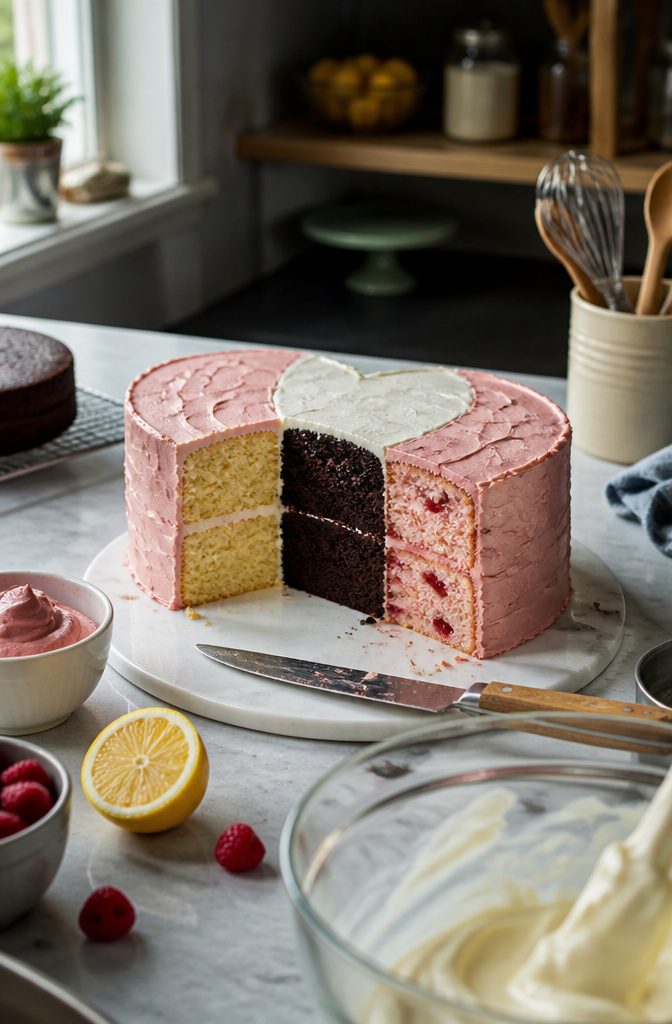
A boxed mix works fine for this cake, and a from-scratch batter isn’t required.
The heart shape and the piping do the showy work either way. Vanilla and lemon are the safest picks: a pale crumb shows off tinted frosting and makes piped lines easy to read.
Chocolate and red velvet give you a deeper, more dramatic slice, and white frosting against that dark crumb looks sharp. Cherry chip is sweet and naturally pink, so it suits a heart cake without extra food coloring.
The vegan raspberry cake needs a different plan.
Cream-cheese frosting is too soft for it, and it will sag under piped detail. Use a sturdier frosting there, and keep the cream cheese for vanilla or red velvet.
Decorating Ideas
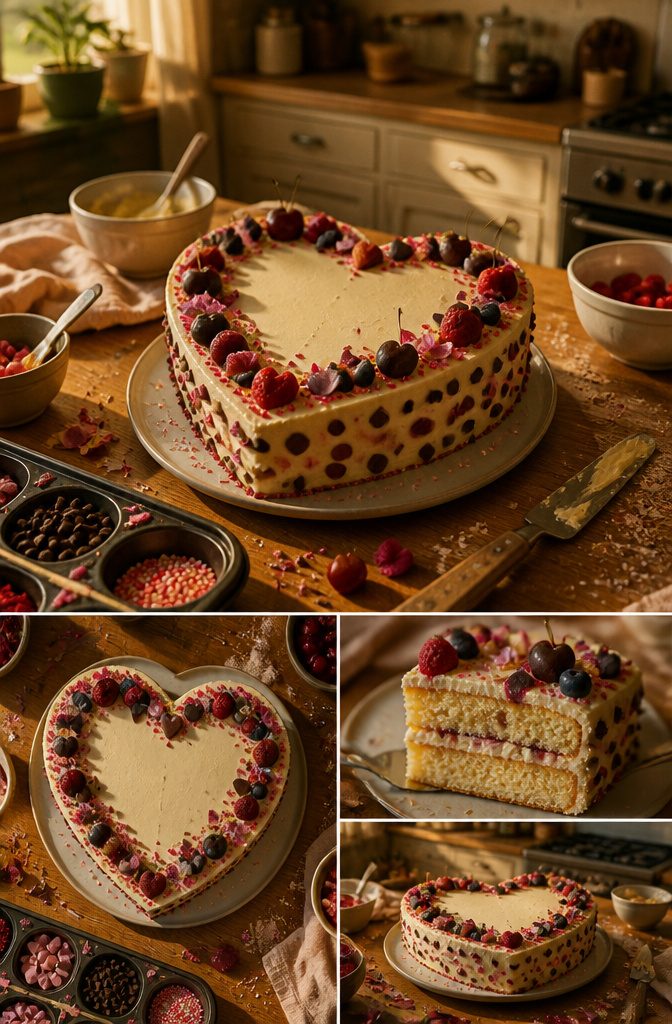
A smooth coat of frosting and nothing else is already finished, but you can go further.
Sprinkles scattered over the top add color in seconds, and fresh berries or cherries ring the edge without extra sweetness. Valentine M&Ms, chocolate chips, or other candies press into the sides for texture and bright contrast against pale frosting.
Chocolate hearts cut from melted chocolate or fondant rolled thin and stamped with a small cutter sit flat on top.
Edible flowers or dried petals bring delicate detail if the occasion calls for it, though they are harder to find at a typical grocery store.
Writing on the cake takes a Wilton Tip 3 and steady pressure.
Common messages like "I love you" or "be mine" fit neatly across the center. If a letter lands crooked, scrape it off gently with an offset spatula and pipe again once the surface smooths.
Chill the cake at least thirty minutes after the crumb coat and at least twenty after the final layer of frosting, or about ten minutes until a light crust forms on the surface before adding decorations that need a firm base.
Vintage Piping Basics
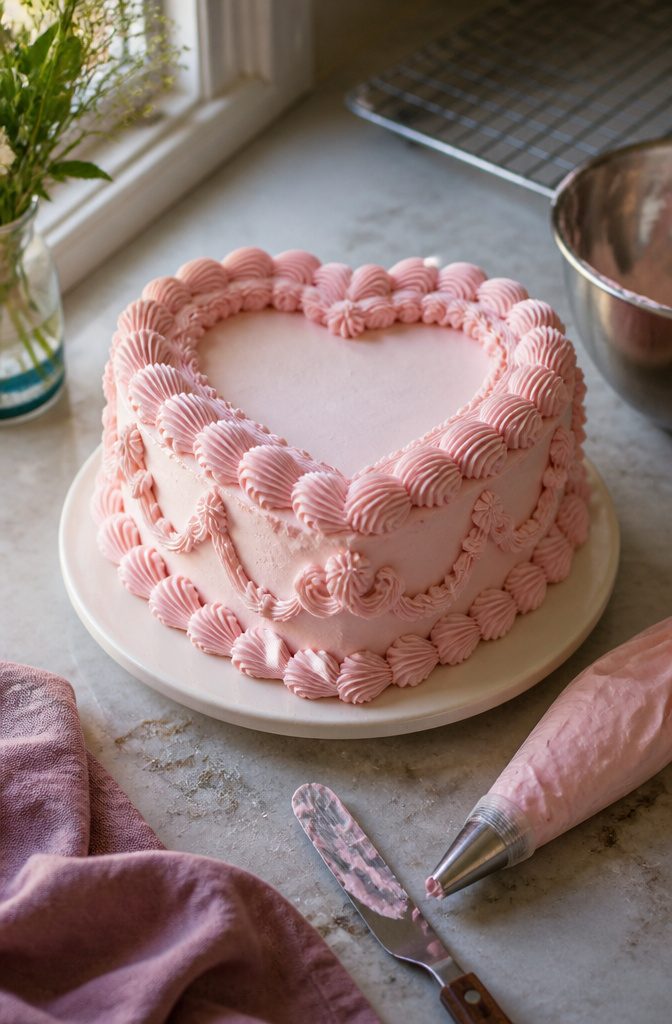
The classic look starts with shell borders piped at a 45-degree angle along the top and bottom edges of the cake.
Squeeze the bag until the buttercream fans out and forces the tip upward, then relax pressure as you lower the tip and pull toward you to create a tail.
Pipe the next shell directly onto that tail. Wilton Tip 4B gives you the large outer border, Wilton 32 handles the smaller inner shells, and you can also use Ateco 844 or Wilton 27 for variations in size and texture.
For the garlands along the sides, divide each side of the cake into five equal parts and mark the top of each section with a toothpick.
That keeps the swoops symmetrical instead of guessing by eye. Use Wilton Tip 5 or Tip 3 to pipe from one mark to the next, letting the frosting droop into place before attaching it at the next dot.
Ruffles add movement. Hold Wilton Tip 102 at a 45-degree angle with the skinny end facing away from the cake, then squeeze as you move your hand slightly up and down to create the ruffle texture while piping a semicircle.
Layer a second ruffle on top of the first for a double garland.
Frosting Color and Consistency
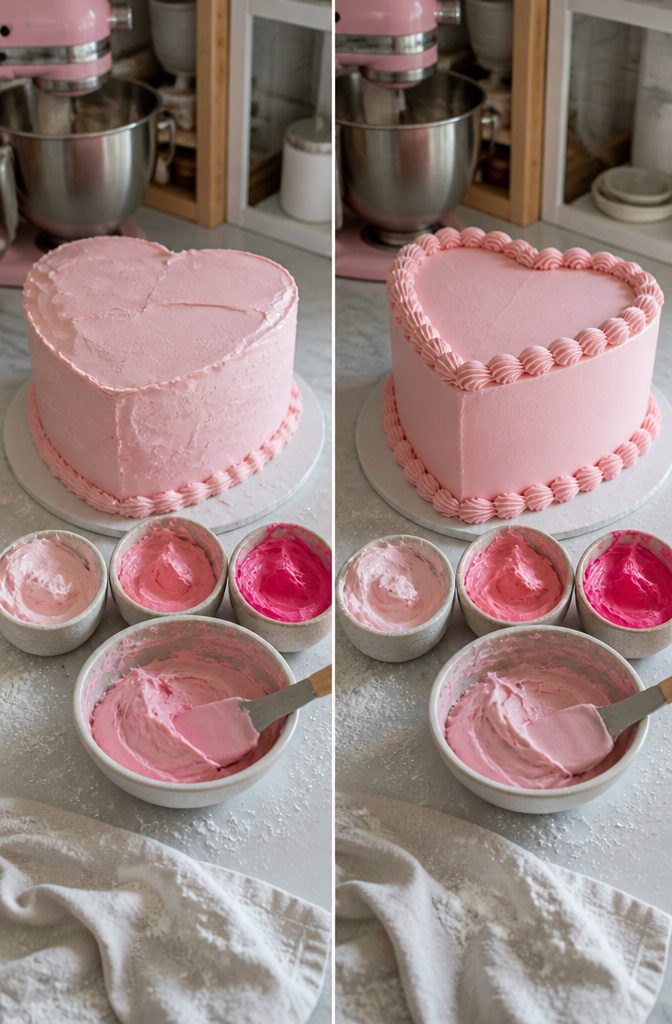
Pipe with medium-consistency buttercream.
Soft frosting wilts once it’s piped, and stiff frosting leaves intricate work looking jagged. If yours is stiff, beat in a dash of dairy-free milk.
For gel color, 1 drop of AmeriColor Deep Pink tints a large batch (about 9 cups) light pink.
Split off portions for deeper shades: 2 drops of Deep Pink makes a darker pink, and 2 drops of Fuchsia plus 2 drops of Deep Pink makes a bold fuchsia.
For natural color, ½ teaspoon of berry powder gives light pink, and another ⅜ teaspoon makes a darker pink for piping. Fruit powders darken over time, so stop a shade lighter than you want.
If the frosting looks bubbly, beat it on the lowest speed for 3–5 minutes.
A Vegan Raspberry Version
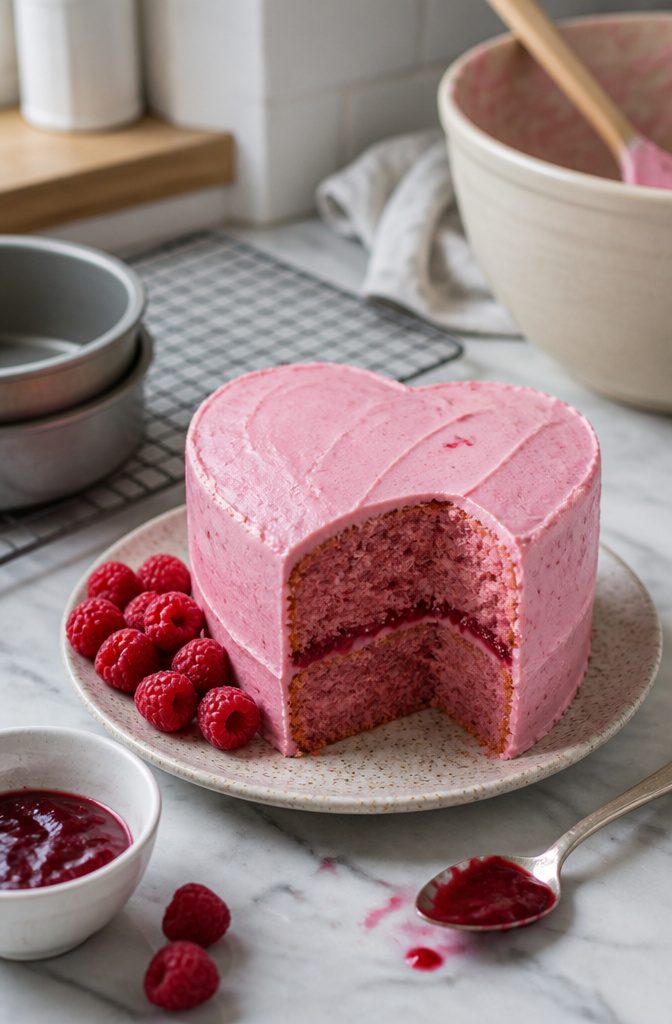
For a dairy-free heart cake, bake the vegan raspberry layers in two 6-inch round pans at 355°F for 43–48 minutes.
The filling can be a quick raspberry jam, cooked for 5 minutes and mashed, and the outside gets berry buttercream. Store-bought jam works too, but keep it to about 100 g, or ⅓ cup.
Any more and the layers slide against each other. If strawberries are what you have, they stand in for the raspberries.
The vintage heart cake in this article is a different matter.
Its batter uses 4 eggs, too many to replace well, and vegan cream cheese doesn’t act like the regular kind in frosting. For a vegan cake, use this raspberry version instead.
Gluten-Free and Swaps
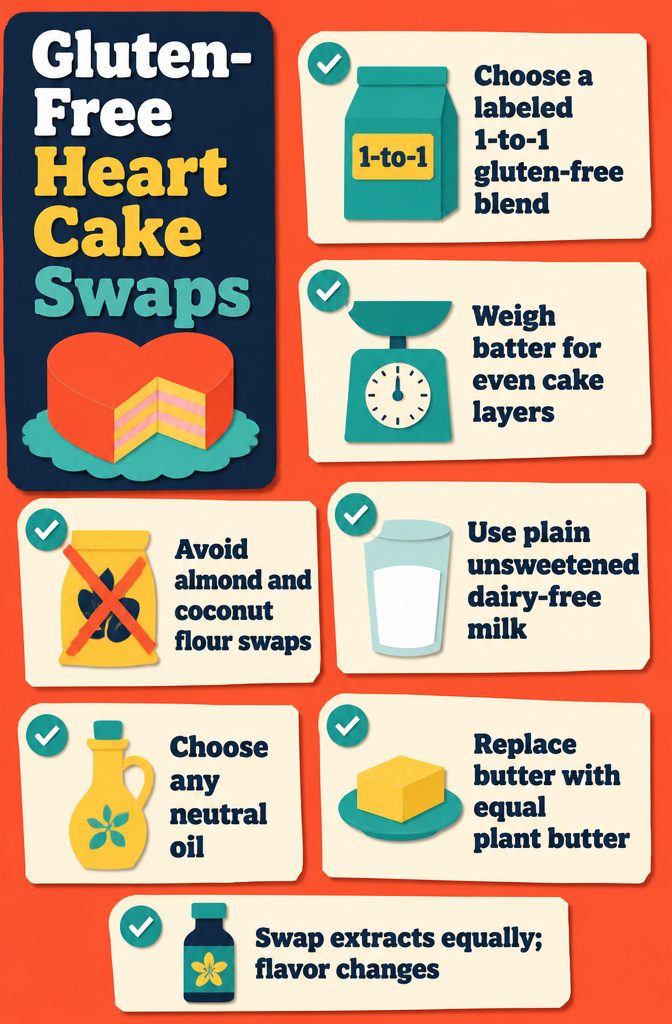
Swap one thing at a time so you can tell what changed if the cake bakes differently.
- Use a 1-to-1 gluten-free baking blend in place of all-purpose flour, and stick with a blend labeled that way. Other gluten-free mixes may not bake the same.
- Weigh the batter as you divide it between pans. Blends can make slightly more or less batter than the standard recipe, and even layers matter for a clean heart.
- Skip almond flour and coconut flour. They are not direct replacements for all-purpose flour, and a straight swap gives a dense or dry cake.
- Milk: use a plain, unsweetened dairy-free milk in the same amount.
- Oil: any neutral oil works, so use what you have.
- Butter: use a plant-based butter in equal amounts.
- Extracts: swap one for another in the same amount, knowing the flavor will change.
Make Ahead and Storage
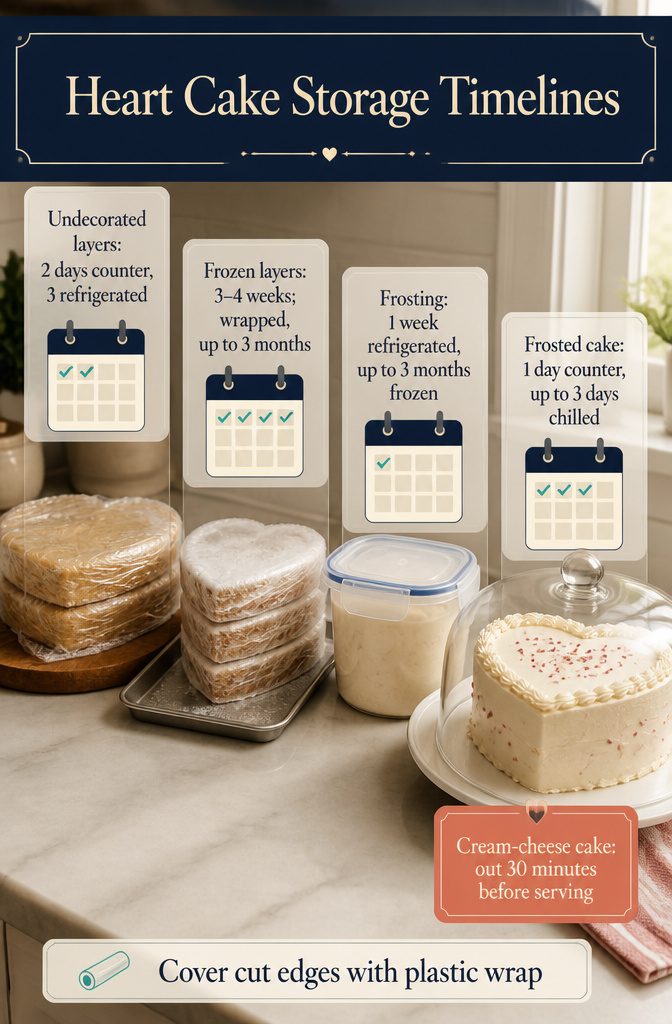
Each part of a heart cake runs on its own clock:
- Undecorated layers keep 2 days at room temperature or 3 days in the fridge, wrapped tightly in plastic so they don’t dry out.
- Frozen layers hold 3–4 weeks with no loss; well-wrapped ones can stretch to 3 months. Thaw at room temperature, and they’re still easier to decorate while cold.
- Frosting keeps up to 3 months frozen or 1 week in the fridge. Bring it to room temperature and stir a few times before using.
- A frosted cake keeps 1 day on the counter or up to 3 days in the fridge. Cream-cheese frosting belongs in the fridge, so take the cake out about 30 minutes before serving.
- Cover cut edges with plastic wrap.
Baking With Kids
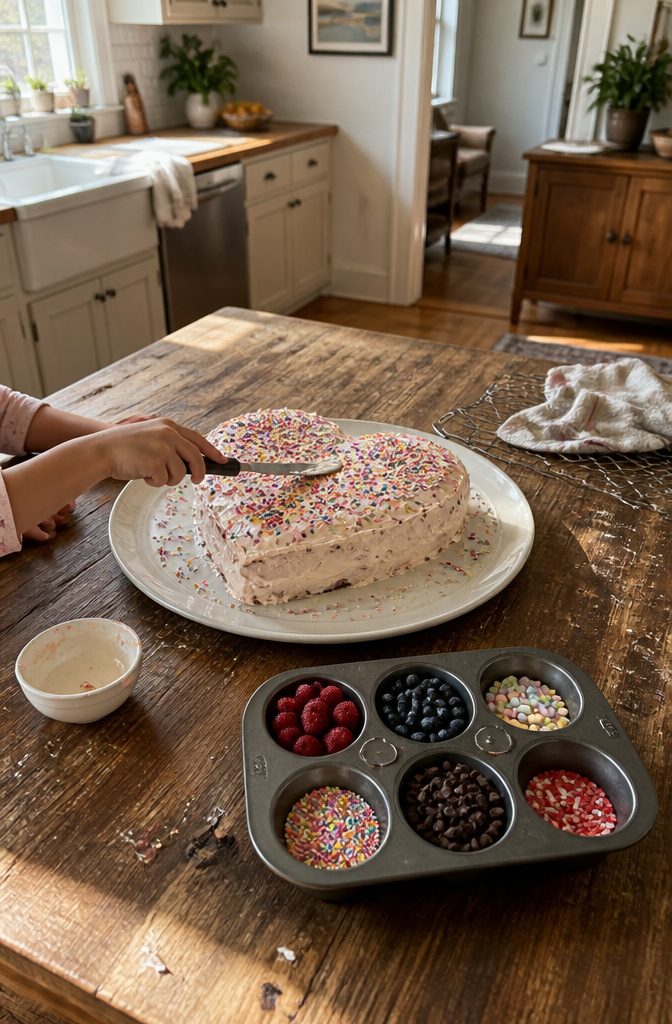
Set out the decorations before anyone touches the cake.
Spoon sprinkles, candies, chocolate chips and berries into the cups of a muffin tray so each child can pick their favorites. Raspberries and strawberries go well with chocolate, and Valentine M&Ms give you a themed look without extra shopping.
Cutting and oven work stay with you. That means moving the pans in and out of the oven and slicing the cake into its heart shape.
Once the cake has cooled and you’ve arranged the pieces, hand over the spatula. Frosting is the best kid job in the recipe, because crooked swipes don’t matter and a thick layer of sprinkles hides the rest.
Frequently Asked Questions
How do you make a heart cake without a heart-shaped pan?
Bake one 8-inch square cake and one 8-inch round cake, then cut the round in half.
Set the square on a diagonal and press the two halves against its upper sides to form the curves. Seal the seams with frosting, crumb coat, chill, then frost and decorate.
What are the measurements for making a heart cake?
Use an 8-inch square pan and an 8-inch round pan, a platter at least 14 inches square, and about 3 cups of frosting.
Bake at 350°F for 30–35 minutes. 9-inch pans also work, but the cake comes out thinner and bakes faster.
How do you cut a perfect heart shape?
Level any domes, then slice the round cake straight across the middle with a large serrated knife. A short 30-minute freeze beforehand makes the crumb less fragile and the cut cleaner.
If you start with stacked round layers instead, mark two 5-inch lines at a right angle to form the point, cut off the two pieces, and use the first trimmed layer as a template for the second.
How many layers should a heart cake be?
One layer is the standard, made from a single square and a single round cake.
For a taller cake, double the recipe and bake 2 round and 2 square cakes in 8-inch pans, then build a second heart on top. Chill or freeze the first heart until the filling is firm so the top one sits level.
Can I bake the full recipe in a large heart-shaped pan?
No.
The batter has to be divided between two pans or it won’t bake properly. If you want to use a heart pan, pick a recipe written for one.
Do I have to use a cake mix?
No.
A homemade cake recipe in any flavor works just as well as a boxed mix. Bake it in the same 8-inch square and 8-inch round pans.
What other decorations can I add to a heart cake?
Sprinkles, fresh berries or cherries, and candies like Valentine M&Ms or chocolate chips all work.
You can also add flat chocolate hearts, fondant cutouts, or edible flowers. A piped message across the center finishes it.
What should I write on a vintage heart cake?
Short messages fit best, since the top has limited room.
Try "I love you," "be mine," or "xoxo" for Valentine’s Day, or a birthday wish like "happy birthday" or the person’s age spelled out. Short song lyrics also work if they mean something to the recipient.
What kind of buttercream is best for vintage piping?
Medium-consistency buttercream.
Soft frosting wilts after piping, and stiff frosting leaves detailed work looking jagged. If yours is too stiff, beat in a small splash of milk.
What piping tips do I need for a vintage heart cake?
Use Wilton 4B for the large shell border and Wilton 32 for smaller inner shells. Wilton Tip 5 or Tip 3 pipes the side garlands, Tip 102 makes ruffles, and Tip 3 handles the lettering.
Can I make a vegan heart cake?
Its batter uses 4 eggs, which are too many to replace well, and vegan cream cheese doesn’t behave like regular cream cheese in frosting. Use the vegan raspberry version instead, which is built for a dairy-free, egg-free cake.
What can I use in place of butter for a dairy-free heart cake?
Use a plant-based butter in the same amount as the butter in the recipe.
Swap plain, unsweetened dairy-free milk for regular milk in equal amounts too. Change one ingredient at a time so you can tell what caused any difference in the bake.
Can I make a heart cake gluten-free?
Yes. Replace the all-purpose flour with a 1-to-1 gluten-free baking blend, and use one labeled that way.
Weigh the batter as you divide it between pans so the layers stay even, and skip almond or coconut flour, which give a dense or dry cake.
What can I use in place of raspberries?
Strawberries. Cut them into halves or quarters and use them wherever the recipe calls for raspberries.
How much store-bought jam should I use for the filling?
Use about 100 g, or ⅓ cup. More than that makes the layers slide against each other.